Roof rat removal services in Greensboro, NC
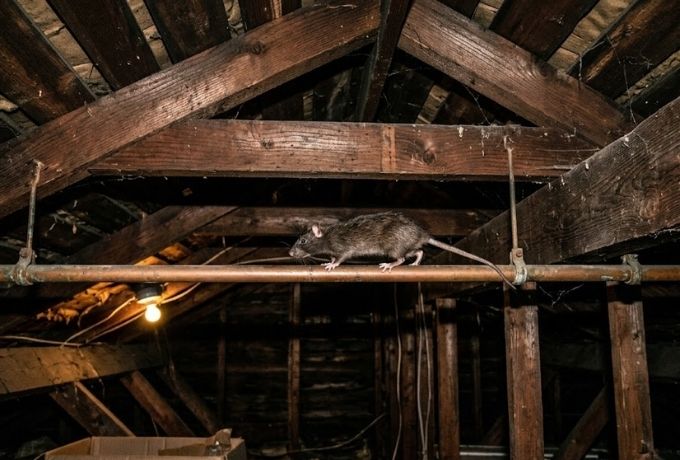
Roof rats (Rattus rattus) are arboreal rodents — they live in trees, travel limb-to-limb across canopy, and drop onto rooflines when a branch touches an eave. In Greensboro's heritage neighborhoods, that canopy has been growing for 80–100 years. Irving Park, Fisher Park, Old Irving Park, Latham Park, and Sunset Hills have the densest roof-rat pressure in Guilford County, and the oldest homes with the most entry-point vulnerabilities. We remove roof rats and seal the structure from the roofline down.
The canopy-to-roofline pathway
The access sequence works like this: a roof rat travels through the canopy network, reaches a limb that contacts or overhangs a roofline, drops onto the roof surface, and explores the perimeter for gaps. Greensboro's older homes provide abundant options. Original wood gable vents often have rusted or missing screens. Soffit-return intersections at eave ends develop gaps as wood expands and contracts across decades. Ridge vents installed during roofing upgrades are sometimes improperly screened. Pipe penetrations through the roof plane — plumbing stack, exhaust vent — occasionally have gaps at the flashing collar. A quarter-inch gap is enough; roof rats are slender and flexible.
Once inside the attic, roof rats establish a colony. They shred insulation for nesting material, gnaw on electrical wiring (a fire risk), deposit droppings throughout the attic floor, and contaminate insulation with urine. A colony that's been established for one full breeding cycle — about three months — can number 10–30 individuals and produce significant attic damage.
Entry points we targetThe 7 most common roof-rat entry points in Greensboro homes
Gable vents
Original wood-frame gable vents with deteriorating screen — the most common roof-rat entry in pre-1970 Greensboro homes. Replaced with 1/4" hardware cloth in a galvanized or stainless frame.
Soffit returns
The intersection of soffit and fascia at eave ends — wood movement over decades creates gaps. Sealed with galvanized flashing or rigid foam board backed with hardware cloth.
Ridge vents
Improperly screened ridge vents installed during roofing upgrades. Requires internal baffle screening without compromising attic ventilation.
Plumbing stack penetrations
Gaps at the flashing collar where plumbing vents exit through the roof plane. Sealed with pipe-collar flashing and copper mesh.
Chimney-to-soffit gaps
Where the chimney chase meets the roofline — a common gap point in older brick chimneys with wood-frame surround.
Limb-contact points
Not a building gap but a canopy access point. Identified during inspection; we document which limbs are creating contact and recommend specific trimming to an arborist.
HVAC penetrations
Where condensate lines and refrigerant lines exit through exterior walls near the roofline. Foam-sealed during original install; foam degrades and roof rats exploit the gap.
How roof rat removal works in a Greensboro attic
Attic & roofline inspection
Full attic walk to map droppings distribution, nesting sites, gnaw damage, and runways. Roofline exterior inspection to identify every entry point — gable vents, soffit returns, ridge, and penetrations.
Attic trap network
High-density snap-trap placement along confirmed attic runways before any sealing. We trap for 10–14 days minimum to clear the population before permanent exclusion sealing. Trapping after sealing risks walling survivors in.
Roofline exclusion sealing
Seal every identified entry point with species-appropriate materials. Gable vents get 1/4" hardware cloth frames; soffit gaps get galvanized flashing; pipe penetrations get pipe-collar flashing with copper mesh. Heritage homes get stainless alternatives where visible.
Follow-up & canopy note
Return 14–21 days after sealing to confirm no new attic activity. Document canopy contact points for arborist referral. Attic cleanup and insulation assessment quoted separately if population was significant.
Greensboro neighborhoods with the highest roof-rat pressure
These neighborhoods combine the two factors that drive roof-rat calls: mature hardwood canopy and older homes with original soffit systems. If you're in one of these areas and hearing scratching overhead, it's a roof-rat call until proven otherwise.
Densest oak canopy in Greensboro, early 1900s craftsman homes
Original Irving Park estate lots, oldest housing stock
Post-war expansion, same canopy density as original Irving Park
Turn-of-century homes, alley systems, mature mixed canopy
1950s–60s homes under dense oak cover, aging soffits
1930s–50s housing, canopy-dense blocks near Friendly Ave
Lakeside lots with mature tree cover, multi-entry rooflines
Established suburb, wooded back lots, creek-corridor canopy
Roof rats in your Greensboro attic? Call (844) 635-0403
Free inspection — we walk the attic and the roofline, identify every entry point, and give you a written quote. Greensboro canopy neighborhoods are our specialty.
Call (844) 635-0403Roof rat removal cost in Greensboro
Standard program
Attic trap network, gable-vent screening, soffit sealing, and follow-up clearance for a typical Greensboro home with 1–3 entry points.
Complex roofline
Large attic footprint (over 1,800 sq ft), multiple entry points, or heritage home requiring stainless-steel screening and preservation-friendly materials.
With attic cleanup
Removal program plus attic decontamination — droppings removal, antimicrobial treatment, and insulation assessment. Significant infestations only.
Attic insulation replacement, if needed, quoted separately after inspection. Free roofline and attic inspection — written quote before work starts.
Roof rat removal in Greensboro — FAQ
Why are roof rats worse in Irving Park, Fisher Park, and Sunset Hills?
Those three neighborhoods sit under Greensboro's densest mature hardwood canopy — oak and maple trees that have been growing since the early 1900s. Roof rats are arboreal: they live in trees, travel limb-to-limb, and use canopy cover as a protected highway. When a tree limb touches or overhangs a roofline, roof rats move from limb to roof within a day or two. The older homes in these neighborhoods also have original soffit systems, wood gable vents, and aging fascia boards that provide multiple entry points once rats reach the roofline.
How do I know if I have roof rats versus Norway rats in my attic?
Roof rat droppings are banana-shaped with pointed ends, about 1/2 inch long. Norway rat droppings are capsule-shaped with blunt ends, about 3/4 inch. Beyond droppings, roof rats concentrate activity above the ceiling plane — attic scratching that tracks across the ceiling rather than up walls. Norway rats typically enter at ground level and work upward; roof rats enter at the roofline and work downward. The entry-point location is usually the clearest indicator.
Do I need to trim my trees to get rid of roof rats?
Canopy trimming is the most effective long-term prevention measure for roof-rat-prone neighborhoods like Irving Park and Fisher Park. Removing limb-to-roofline contact points breaks the primary access route. We recommend trimming to maintain at least 6 feet of clearance between tree limbs and any part of the roofline or structure. We don't do tree trimming ourselves, but we document which specific limbs are creating contact points during inspection so you can direct an arborist precisely.
Is the roof rat removal process different for historic homes in Greensboro?
Yes. Historic homes in Irving Park, Fisher Park, and Sunset Hills require heritage-friendly exclusion — we avoid drilling or cutting into original architectural elements, use stainless-steel mesh rather than galvanized hardware cloth where visible, and match materials to existing vent systems. The goal is sealing the structure against roof rats while preserving the character of the home.
How much does roof rat removal cost in Greensboro?
A standard roof rat removal program — attic trap network, gable-vent screening, soffit-return sealing, and follow-up clearance — runs $800–$2,000 for most Greensboro homes. Large attic footprints, complex rooflines with multiple entry points, and historic homes requiring heritage-friendly materials fall at the higher end. Attic cleanup and insulation replacement, if needed after a significant infestation, are quoted separately.