Attic rodent proofing in Greensboro, NC
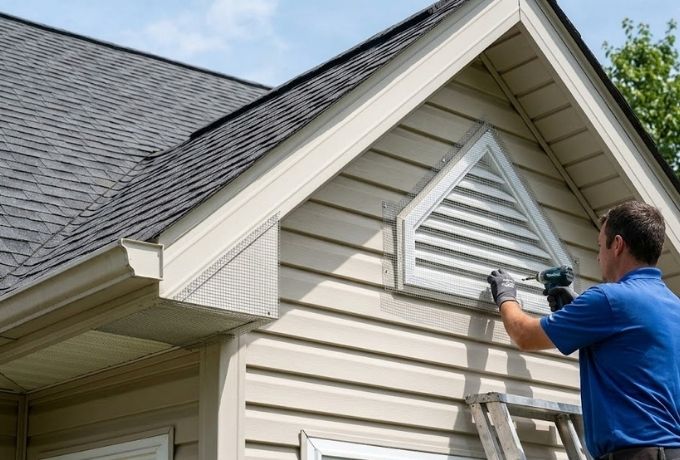
Roof rats enter Greensboro attics through the same openings that allow the attic to breathe — gable vents, soffit returns, ridge vents, and pipe penetrations. The challenge of attic rodent proofing is sealing every entry point without compromising the ventilation those openings provide. We install 1/4-inch mesh in fitted frames, apply internal baffle screening at ridge vents, and use flashing at soffit gaps — all methods that block rodents while preserving airflow.
How attic rodent proofing differs from general exclusion sealing
An attic in Greensboro's humid subtropical climate needs ventilation to prevent moisture accumulation, condensation on roof sheathing, and the mold growth and wood rot that follow. Gable vents, soffit vents, and ridge vents are designed to create the cross-ventilation that keeps the attic dry. Plugging them solid — even with rodent-grade mesh — reduces that ventilation and creates a secondary problem.
The solution at every attic entry point is mesh framing that blocks rodents while allowing the designed airflow to pass through the mesh openings. A 1/4-inch hardware-cloth frame has roughly 80% open area — essentially full ventilation with zero rodent passage. Ridge-vent baffle screening preserves the ridge channel while eliminating the gap at the vent edges. Soffit flashing closes the wood-separation gap without affecting the soffit vent perforations below it.
Attic entry points — methods at eachWhere roof rats enter Greensboro attics and how we seal each point
Gable vents
Custom 1/4" galvanized or stainless-steel hardware-cloth frame fitted to the interior face of the gable-vent opening. Frame is secured to the surrounding framing, not the vent itself. Original vent preserved. No drilling into exterior architectural elements.
Soffit returns
Custom-bent galvanized or aluminum flashing closing the gap at the soffit-to-fascia intersection. Sized to the specific gap width. Does not block the soffit vent perforations — closes only the structural separation gap that develops over decades of wood movement.
Ridge vents
Internal baffle screening installed at the ridge vent's interior face — preserves the full ridge ventilation channel while closing the gap at vent-cap edges where roof rats enter. Applied from inside the attic without disturbing the exterior roof surface.
Plumbing stack penetrations
Gaps at the flashing collar where plumbing vent pipes exit through the roof plane. Sealed with pipe-collar flashing and copper mesh packed into the gap at the collar edge — rodent-proof and weather-tight.
HVAC penetrations at roofline
Where condensate lines and refrigerant lines exit through exterior walls near the roofline. Typically foam-sealed at installation; foam degrades and roof rats exploit the gap. Replaced with copper mesh and appropriate exterior sealant.
Chimney-to-fascia gaps
Where the chimney chase meets the adjacent roofline — a gap point in older brick chimneys where the wood-frame surround has separated from the brick. Sealed with flashing or mortar appropriate to the substrate.
How attic rodent proofing works
Attic & roofline inspection
Walk the attic interior and inspect the roofline exterior. Document every entry point with photography. Assess ventilation configuration and confirm that proposed sealing methods preserve required airflow at each point.
Population clearance confirmation
Proofing proceeds only after attic trap network confirms population is cleared — no new trap strikes for 5+ days. Never seal with active rodents in the attic.
Ventilation-preserving seal installation
Install mesh frames at gable vents, flashing at soffit gaps, baffle screening at ridge vents, and copper mesh at penetrations. Every method preserves designed ventilation. Written seal-point documentation provided.
Follow-up verification
Return 14–21 days after proofing to inspect all sealed points for gnaw marks or new pressure. Written clearance note provided at confirmed completion.
Roof rats in your Greensboro attic? Call (844) 635-0403
Free attic and roofline inspection — we find every entry, propose ventilation-preserving sealing methods, and quote before any work starts.
Call (844) 635-0403Attic rodent proofing cost in Greensboro
Standard attic proofing
Gable-vent screening, soffit-return flashing, ridge-vent baffle, and pipe-penetration sealing. Standard residential roofline.
Complex roofline
Multiple gable vents, difficult soffit access, heritage-home stainless mesh, or large attic footprint requiring extended scaffold access.
Proofing + removal
Complete roof rat program — attic trap network, population clearance, full roofline proofing, and follow-up. Irving Park / Fisher Park standard.
Free inspection and written entry-point count before quoting. All programs include follow-up verification visit.
Attic rodent proofing — FAQ
Does attic rodent proofing affect ventilation?
Not when done correctly. At gable vents, we install 1/4-inch hardware-cloth frames that allow full airflow while blocking rodent entry. At ridge vents, we install internal baffle screening that maintains the ventilation channel. Soffit-return gaps are sealed with flashing rather than plugging the soffit vent itself. Improper attic rodent proofing that blocks ventilation creates moisture and heat problems — we're careful to avoid that at every point.
What's the most common attic rodent entry point in Greensboro?
For most Greensboro homes, the gable vent is the primary entry — particularly on pre-1970 homes with original wood-frame gable vents and deteriorated screens. The second most common is the soffit-return gap at eave ends. On homes with ridge vents installed during roofing upgrades, improperly screened ridge vents are increasingly common as a third entry vector.
Should I proof the attic before or after treating the rat infestation?
After — always. Attic rodent proofing must follow confirmed population clearance. If gable vents and soffits are sealed while roof rats are still active in the attic, the sealed population has no exit, dies inside, and produces weeks of decomposition odor in the living space below. The correct sequence: attic trap network → confirmed clearance → exclusion sealing → follow-up verification.
Do squirrels and bats use the same attic entry points as roof rats?
Yes. Gable vents, soffit gaps, and ridge openings are used by roof rats, gray squirrels, and occasionally little brown bats. Our attic proofing seals against all three. For bat colonies, NC law governs timing — bats may not be excluded during the maternity season (May 15–August 1 in NC) when pups are flightless. We note bat activity during inspection and discuss timing requirements before any exclusion work near known bat roosts.
How much does attic rodent proofing cost in Greensboro?
Standard attic proofing runs $400–$1,000 for most Greensboro homes. Complex rooflines with multiple gable vents or heritage-home requirements fall in the $800–$1,500 range. Free inspection and written entry-point count before quoting.