Rodent exclusion services in Greensboro, NC
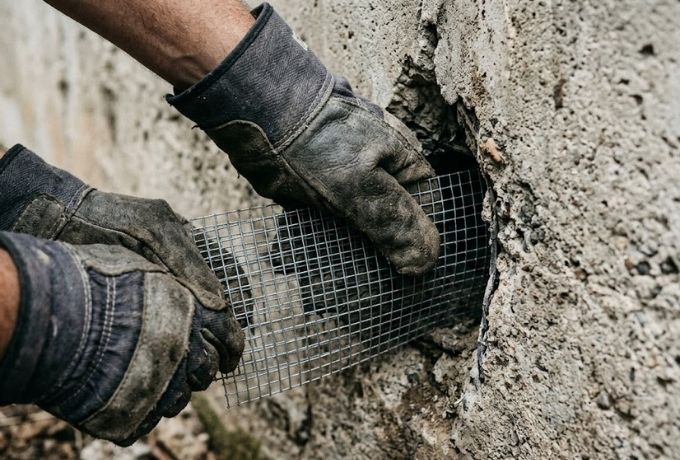
Trapping removes the rodents currently in your home. Exclusion sealing is what stops the next generation from following the same entry paths. Every recurring rodent infestation in Greensboro — the annual October Norway rats, the roof rats that return every September — has the same cause: an open entry point that was never sealed with rodent-grade materials. Exclusion is the permanent part of the solution, and it works only when every entry point is found and every material choice is made correctly.
The trapping-only failure pattern — and why it repeats every fall
The most common rodent call we receive in Greensboro is a repeat customer — someone who had a rat or mouse problem last year, had it "treated," and now has it again. In nearly every case, the prior treatment involved trapping without exclusion sealing. The traps cleared the population that was already inside. The entry point stayed open. When rodent pressure spiked the following fall, the new population followed the old scent trails to the same entry and moved in without resistance.
This pattern repeats because exclusion is the time-consuming, materials-cost part of rodent work. It requires finding every entry point — including the secondary ones that rodents exploit when primary entries are blocked — and installing the right material at each point. Expanding foam alone fails for rats and mice within weeks because they chew through it. Hardware cloth screwed over a vent opening without a proper frame fails when the screw pulls out of aging wood. Sealing that looks complete from outside often leaves gaps at corners, pipe transitions, or where two materials meet.
Our exclusion standard: every identified entry point sealed with rodent-grade material, every seal documented in writing, and a follow-up inspection 2–3 weeks later to confirm no new breach has emerged.
Rodent-grade exclusion materials by gap type
Material selection is the difference between an exclusion seal that holds for decades and one that fails within a season. The right material depends on gap size, location, structural material, and whether the seal needs to be cosmetically appropriate.
1/4" hardware cloth — galvanized or stainless
1/4-inch (6mm) galvanized or stainless welded wire mesh in a custom-fitted frame. Galvanized for protected areas; stainless for visible or moisture-exposed locations. The frame is what matters — loose mesh stapled over an opening will pull away within months.
Copper mesh + appropriate sealant
Copper mesh packed tightly into the gap around the pipe, followed by a sealant compatible with the substrate. Copper doesn't compress like steel wool and doesn't corrode like galvanized mesh in moisture-exposed locations. Never foam alone at pipe penetrations — rats chew through it.
Lime mortar or Portland patch with mesh backing
Mortar gaps in concrete-block foundations are patched with a mortar compatible with the original substrate, with copper mesh or hardware cloth backing. For historic brick, lime-compatible mortar to avoid damaging the original brick face.
Galvanized or aluminum flashing
Custom-bent galvanized or aluminum sheet flashing closing the gap at the soffit-to-fascia intersection. For heritage homes, pre-painted aluminum matched to the original soffit color.
Copper mesh + foam backer + sealant
Copper mesh pressed into the gap, backed by a foam backer rod to fill depth, sealed with a paintable exterior sealant. The mesh prevents rodent passage; the sealant and backer rod prevent weathering that would reopen the gap.
Heavy-gauge aluminum brush sweep
Standard hollow-core aluminum door sweeps are inadequate — rodents compress past the thin rubber bulb. Heavy-gauge aluminum brush sweeps with dense nylon bristles provide flexible but impenetrable closure at the door threshold.
Full-property rodent exclusion — how it works
Entry-point audit
Systematic inspection of the full building envelope — foundation perimeter, crawl-space vents, sill plate, pipe penetrations, garage threshold, roofline, gable vents, soffit returns, and ridge. Every potential gap photographed and documented.
Population clearance confirmation
Exclusion only proceeds after confirming the active population has been removed. If trapping is needed before sealing, we complete that phase first. Sealing with active rodents inside produces a worse outcome than no sealing at all.
Material-appropriate sealing
Each identified entry point sealed with the appropriate material for that gap type, location, and substrate. Every sealed point documented with location, material used, and install date. Written seal-point log provided at job completion.
Follow-up verification
Return 14–21 days after exclusion to inspect all sealed points for signs of new rodent pressure — gnaw marks at sealed areas, new gaps adjacent to sealed points, or secondary entry points that became active after primaries were closed.
Recurring rodent problem in Greensboro? Exclusion is the fix. Call (844) 635-0403
Free inspection — we find every entry point and seal with rodent-grade materials. Written documentation of every sealed point included.
Call (844) 635-0403Rodent exclusion cost in Greensboro
Exclusion-only (post-treatment)
Full-property exclusion sealing after existing treatment has cleared the population. Includes written seal-point documentation and follow-up verification.
Treatment + exclusion combined
Complete program — treatment, population clearance, and full exclusion sealing. The standard approach for first-time infestations.
Heritage-grade exclusion
Stainless and copper materials, custom vent frames, no-drill attachment at original wood elements. Irving Park, Fisher Park, and Sunset Hills craftsman homes.
Commercial exclusion
Commercial properties, warehouses, and multi-unit buildings quoted after walkthrough. Perimeter exclusion combined with bait-station monitoring programs.
All exclusion programs include a written seal-point log. Free inspection, written quote before work starts. Follow-up verification included in all exclusion programs.
Rodent exclusion — FAQ
What materials do you use for rodent exclusion sealing?
The right material depends on gap type, location, and species. For vent openings and structural gaps, we use 1/4-inch hardware cloth in custom-fitted frames. For pipe penetrations, we use copper mesh packed into the gap followed by appropriate sealant — never foam alone, which rodents chew through. For foundation-block mortar gaps, lime-compatible patching mortar with copper mesh backing. For door sweeps, heavy-gauge aluminum brush seals. Expanding foam is used only as a backing material behind rodent-grade mesh, never as the primary seal.
Does exclusion work if I still have active rodents in the building?
Exclusion must be sequenced correctly — trapping first, sealing second. If we seal a building with active rodents inside, we wall in the population. Trapped rodents die in walls, decompose, and produce odor. The correct protocol is always: trap and confirm the population is cleared, then seal every entry point. We never reverse this sequence.
How long does rodent exclusion last?
Properly installed rodent-grade exclusion sealing is essentially permanent for structural gaps — hardware cloth in a secure frame at a foundation vent will hold for decades. Maintenance items: door sweeps degrade over 3–5 years and should be inspected annually, sealant at pipe penetrations can crack in freeze-thaw cycles. We recommend a perimeter check every 2–3 years for most Greensboro homes.
Can I do rodent exclusion myself?
Partially. Hardware cloth at obvious foundation vent openings, door sweep replacement, and copper mesh at visible pipe penetrations are DIY-accessible. The gaps that require professional exclusion are the ones that require knowing where to look — sill-plate gaps at wood-to-concrete transitions, subtle gaps at utility-line entries, soffit-return separations only visible from the roofline. Incomplete DIY exclusion produces a slower infestation, not a solved one.
How much does rodent exclusion cost in Greensboro?
Exclusion-only work runs $400–$1,200 for most Greensboro homes. Full programs combining treatment and exclusion run $600–$2,000+. Heritage-home exclusion using stainless and copper materials runs 20–30% higher. Free inspection with written entry-point assessment and exclusion quote.