The climate factor — why Greensboro's winters don't provide a rodent pause
Greensboro sits in USDA Plant Hardiness Zone 7b, which puts average winter low temperatures in the 5–10°F range. But those are averages — January daytime highs regularly reach 45–55°F, and mild winters see stretches where overnight temperatures don't drop below freezing for weeks. This climate profile is the key to understanding why Greensboro's rodent population doesn't experience the die-off and dormancy that reduces pressure in colder northern climates.
Rats and mice don't hibernate. They slow down in cold weather — reduced foraging, compressed territory, more time in sheltered locations — but they don't stop. In Greensboro's climate, "slow down" means a modest reduction in activity during December–February, not a cessation. Breeding continues at a reduced rate year-round. By March, populations are rebuilding toward their spring and summer peaks.
The comparison point: a Wisconsin homeowner who treats a Norway rat infestation in November may get genuine relief through April as the population shrinks in sustained cold. A Greensboro homeowner who treats in November without exclusion sealing is likely to see pressure re-emerge by March or April when the population has rebuilt. The treatment is the same; the exclusion requirement is more critical in Greensboro's milder climate.
The infrastructure factor — storm drains, alleys, and the sustained colony network
Greensboro's storm-drain infrastructure provides Norway rats with a protected, temperature-regulated underground travel network that functions year-round. Drain pipes sustain temperatures above freezing in all but the most extreme winter events, and they connect the city's resident Norway rat population across neighborhoods, commercial corridors, and residential blocks without surface exposure.
When heavy rain displaces drain populations — as it does after significant storm events — the rats surface and pressure adjacent properties. When construction disrupts established burrow networks, surrounding properties see influx. The storm-drain system means Greensboro's Norway rat population is not a collection of isolated colonies but a connected network with shared infrastructure, which is why pressure from one address can be influenced by activity several blocks away.
Downtown Greensboro's restaurant alley systems — particularly along Elm Street, Davie Street, and the blocks adjacent — add an organic waste component that sustains alley-resident Norway rat colonies at consistent population levels throughout the year. These colonies don't experience the food-source reduction that drives seasonal population declines in rural or suburban environments.
The housing factor — aging crawl-space stock and mature hardwood canopy
Two physical characteristics of Greensboro's built environment create structural year-round vulnerability. First, the city's pre-war and postwar crawl-space housing stock: homes built between 1920 and 1960 with foundation vent screens that are now 60–100 years old. Corroded screens, deteriorated sill plates, and aging pipe penetrations create entry points that exist and are exploitable in every month of the year. A Norway rat doesn't need mild weather to use a crawl-space gap — it needs the gap to be open.
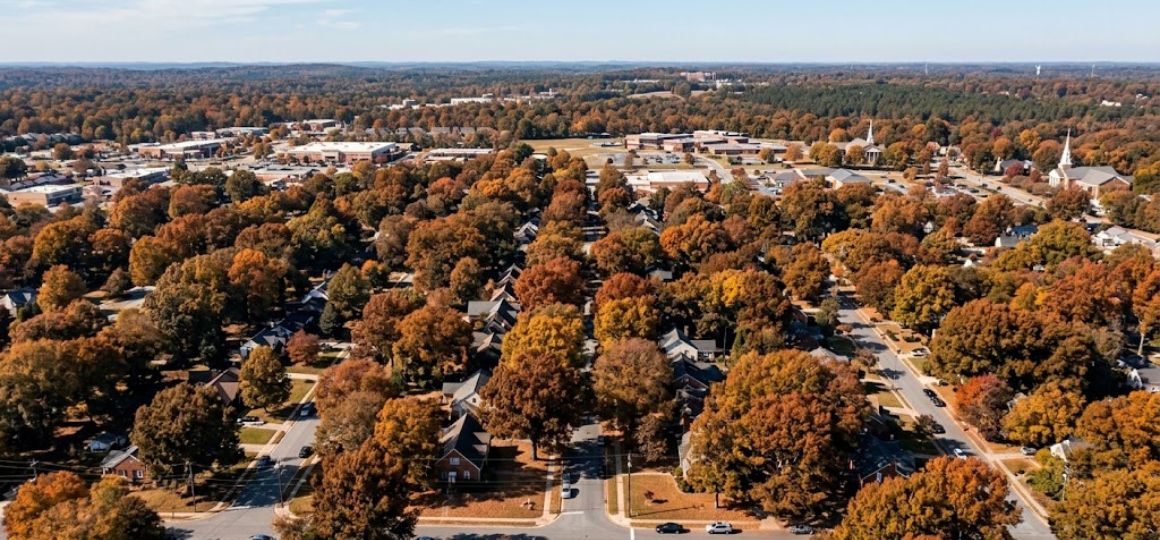
Second, Greensboro's mature hardwood canopy. The oak trees in Irving Park, Fisher Park, Sunset Hills, and Latham Park that make those neighborhoods beautiful also create year-round aerial infrastructure for roof rats. Even in winter, bare limbs maintain physical contact with rooflines — they don't shrink away from the house. A gable-vent gap that's accessible in October is equally accessible in February. The canopy doesn't stop providing access; it just becomes less active.
Seasonal intensity versus baseline — understanding the fall spike
Year-round pressure doesn't mean uniform pressure. Greensboro does have seasonal variation — it's just variation in intensity on top of a year-round baseline, not a seasonal on/off cycle. The fall spike (September–December) is real: roof rats migrate from cooling canopy toward warm attics, Norway rats increase indoor foraging as outdoor food declines, and house mice seek warmth as temperatures drop. This is when the majority of first-call rodent inspections happen.
But the underlying population that produces the fall spike is active year-round. A Norway rat colony in a Greensboro crawl space in July is smaller and quieter than in October, but it's present. A roof-rat pair in an Irving Park attic in February is less active than in November, but it's there. The year-round baseline is why treatment in any month is valid, and why exclusion sealing — the permanent fix — is equally important regardless of when in the year a problem is discovered.
What this means for Greensboro homeowners and property managers
Three practical implications. First, the best time to inspect and seal is not "when you have a problem" — it's before fall pressure peaks. An August or September inspection of crawl-space vents and roofline entry points that finds and seals gaps before the October influx is far more efficient than a November emergency call after roof rats are already established in the attic.
Second, treatment without exclusion sealing produces temporary results in Greensboro's year-round-pressure environment. The replacement population arrives faster here than in colder climates because the source population is never fully suppressed by weather. Exclusion sealing is the permanent component; trapping is the acute-population management component. Both are needed.
Third, for property managers and landlords in high-pressure neighborhoods: year-round pressure means year-round inspection value. A pre-move-in inspection in February is as useful as one in September — because the entry points that need to be documented and sealed are open and exploitable in every month. Call (844) 635-0403 if you'd like to discuss a preventive inspection program for your properties.
Rodent problem in Greensboro or Guilford County?
Free inspection, same-day dispatch available, written quote before any work starts. Licensed in North Carolina. Open 24/7.
Call (844) 635-0403