Why accurate ID from droppings matters
Droppings are the most common initial evidence Greensboro homeowners find — before they ever see a live rodent. Under a kitchen sink, inside a cabinet drawer, scattered across attic insulation, or concentrated near a crawl-space vent. What you do next depends on what you're looking at: mouse droppings indicate a gap around 1/4 inch or smaller, a program that focuses on interior trapping and kitchen-level sealing. Rat droppings — Norway or roof — indicate a larger structural entry and a program that starts with the foundation or roofline.
Getting the ID wrong before calling a pest control company often produces a mismatched program. Here's how to read what you've found.
The size rule — what the measurements actually tell you
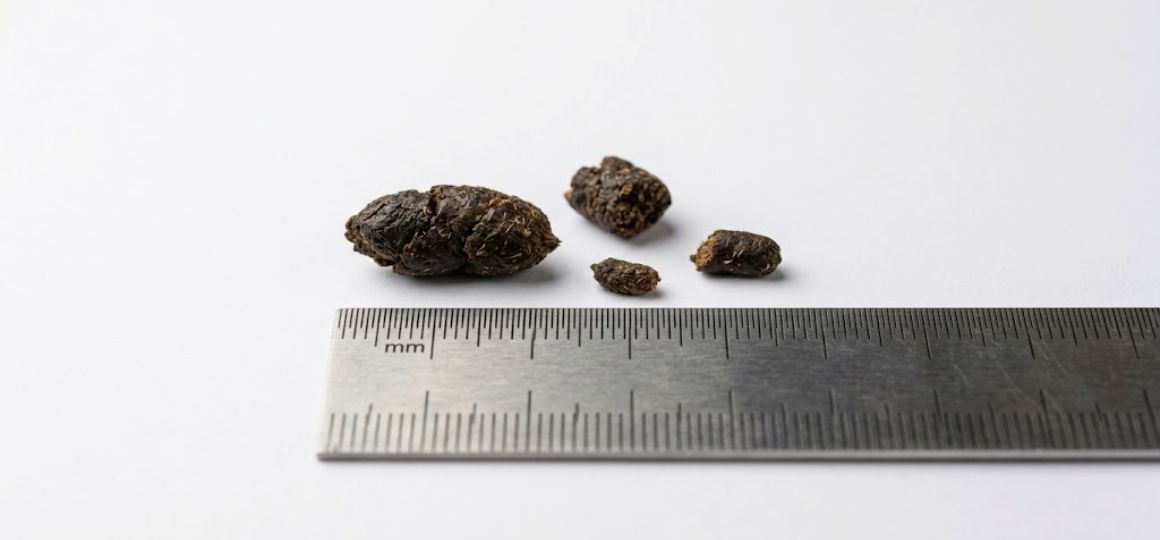
Size is the first and most useful differentiator. House mouse droppings are 3–6mm (1/8 to 1/4 inch) — roughly the size of a grain of rice to a small sunflower seed. Roof rat droppings are 12mm (1/2 inch) — noticeably longer than mouse droppings. Norway rat droppings are 18–20mm (3/4 inch) — the size of a raisin, clearly larger than the others.
If you're unsure, put a ruler next to what you've found before touching it. The size alone narrows the species with reasonable confidence. When droppings are 3/4 inch or longer with blunt ends, Norway rat. When they're 1/2 inch with tapered ends, roof rat. When they're 1/4 inch or smaller, house mouse.
Shape and taper — the species differentiator
Beyond size, shape distinguishes rat species from each other. Norway rat droppings have blunt, rounded ends — like a small capsule. Roof rat droppings have pointed, tapered ends — they look like a tiny banana. Both are larger than mouse droppings, so if you've confirmed the size puts you in rat territory, the end shape makes the species call.
House mouse droppings have pointed ends at both tips, giving them a spindle shape — both ends come to a point. This distinguishes them from Norway rat droppings (both ends blunt) and makes them look like a small, dark rice grain.
Location of droppings — what distribution tells you about severity
A few droppings concentrated in one spot — under the sink, in a single cabinet — suggests recent entry with limited established activity. A small population or a single animal exploring a new entry. This is the scenario where a quick trap-and-seal response is typically sufficient.
Droppings distributed across multiple rooms or levels simultaneously — kitchen and pantry and behind the refrigerator — indicates an established infestation. The population has had enough time to establish multiple foraging routes through the home. Multi-room distribution is the indicator for a multi-visit treatment program rather than a spot fix.
In attic spaces, droppings scattered throughout the insulation layer — rather than concentrated at one nest site — indicate an established roof-rat colony that has been active for at least one full breeding cycle. Attic-wide distribution is the indicator for both a treatment program and an insulation assessment.
Fresh vs. old droppings — how to assess activity timeline
Fresh droppings are dark and moist with a slightly shiny surface. They harden and lighten in color as they age — typically within 48–72 hours they begin losing moisture and turning gray or dusty. Older droppings crumble when touched. Very old droppings are dull, dry, and disintegrate easily.
Finding a mix of fresh dark droppings and older gray ones indicates ongoing activity — both historical and current. Finding only old, gray, crumbling droppings may indicate a past infestation that has resolved, though it can also mean activity has moved to a different area of the structure. We use a fresh-dropping test during inspections: wipe an area clean, return after 24–48 hours, and check for new deposits. New droppings confirm active current infestation; none found suggests either resolved activity or a different zone.
What to do when you find droppings in a Greensboro home
Don't sweep or vacuum dry droppings with standard equipment. Hantavirus and other rodent-borne pathogens become aerosolized when dry droppings are disturbed. Wet the droppings with a diluted bleach solution (1:10 ratio), let sit for 5 minutes, then wipe up with disposable paper towels and dispose in a sealed bag. Wear gloves. If the accumulation is significant — attic-wide, crawl-space-wide — professional HEPA-vacuum cleanup is the appropriate standard.
After cleanup, photograph the area before wiping so you have a record of distribution and volume. Note whether droppings were fresh or old. Note the location precisely. This information speeds up the inspector's assessment significantly and helps calibrate the program scope correctly. Then call (844) 635-0403 — we'll confirm the species and recommend the right program for what you've found.
Rodent problem in Greensboro or Guilford County?
Free inspection, same-day dispatch available, written quote before any work starts. Licensed in North Carolina. Open 24/7.
Call (844) 635-0403