Why the species ID matters before any treatment starts
Greensboro has two established rat species: Norway rats (Rattus norvegicus) and roof rats (Rattus rattus). They're not interchangeable — they occupy different spatial zones in the same city, enter structures at different levels, and require different exclusion approaches. A crawl-space sealing program solves Norway rat access and does nothing for the roof rats in your attic. A gable-vent screening program solves roof rat access and does nothing for the Norway rats below.
This is why a rodent inspection in Greensboro should always confirm species before treatment is recommended. Identifying from droppings, entry-point location, and activity sound is usually straightforward. Misidentifying — or not identifying at all — produces a program that partially works at best.
Physical differences — size, shape, color, and droppings
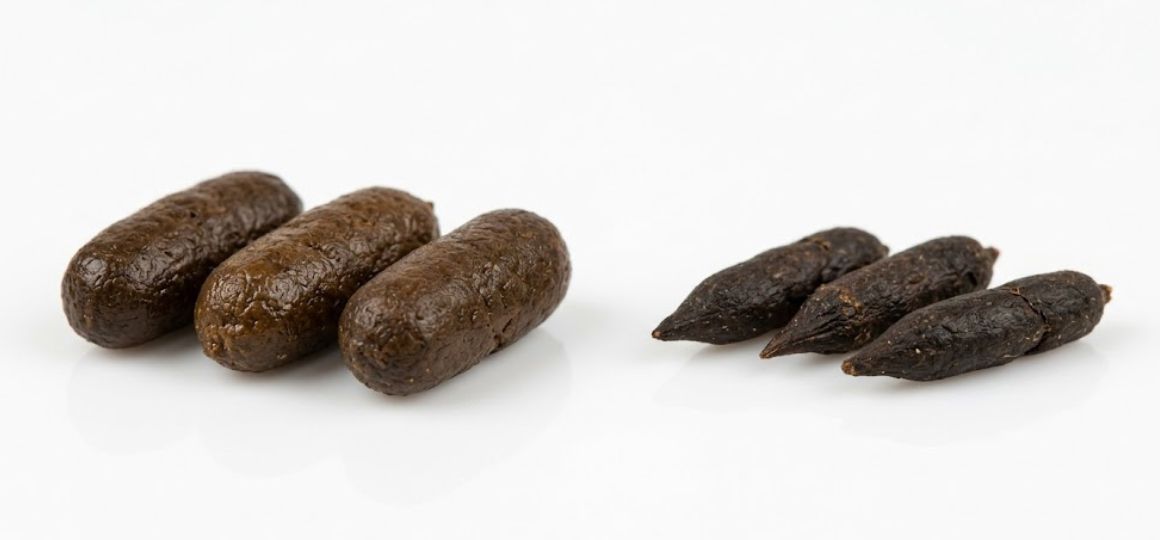
Norway rats are the heavier species: adults reach 10–12 inches of body length with a heavy, blunt-nosed build. Their fur is typically coarse brown with gray undersides. Their tails are shorter than their body length. Their droppings are capsule-shaped with blunt ends, roughly 3/4 inch long — the size of a raisin.
Roof rats are slender and lighter: adults reach 6–8 inches of body length with a pointed nose and large ears. Their fur is smoother, often brownish-gray to black. Their tails are longer than their body length — noticeably so. Their droppings are banana-shaped with pointed ends, about 1/2 inch long — smaller than Norway rat droppings and distinctively tapered.
The dropping comparison is the most reliable field ID when you don't see the live animal: blunt-ended and large means Norway rat; pointed and smaller means roof rat. Both types can appear in the same property if both species are present, which is why location matters — find Norway rat droppings in the crawl space and roof-rat droppings in the attic and you have a dual-species situation.
Behavioral differences — where they live, how they move
Norway rats are neophobically cautious about new objects in their territory — they investigate unfamiliar items before interacting with them, which is why pre-baiting snap traps before activating them dramatically improves strike rates. They're ground-bound: they dig burrows, follow walls and fences, and rarely climb above the first floor of a structure. They're the rats you see running along fence lines in Greensboro's restaurant alley systems.
Roof rats are acrobatic climbers — they navigate electrical wires, tree limbs, and roof edges with precision. They're the species that comes to mind when someone says "I heard scratching in my ceiling at 2 AM" — that ceiling-level movement is characteristic roof rat behavior. They're less neophobic than Norway rats and typically strike traps faster.
Both species are primarily nocturnal. Daytime sightings usually indicate a large population under pressure — more animals competing for resources than the available territory comfortably supports.
Entry-point differences — what you're looking for at your Greensboro home
Norway rat entry concentrates at or below grade — crawl-space vent screens, sill-plate gaps at the wood-to-concrete transition, pipe penetrations through the foundation wall, and gaps at the crawl-space access door. If you're finding droppings in the crawl space and your foundation vent screens are corroded or missing, that's your answer.
Roof rat entry concentrates at the roofline — gable vents, soffit-return gaps, ridge-vent openings, and plumbing stack penetrations through the roof plane. In Greensboro's canopy-dense neighborhoods — Irving Park, Fisher Park, Sunset Hills, Latham Park — any tree limb touching or overhanging the roofline is the delivery mechanism that gets roof rats to those entry points.
The practical implication: Norway rat exclusion sealing is done from the foundation up. Roof rat exclusion sealing is done from the roofline down. A general "seal everything" approach without knowing which species you're addressing may miss the relevant zone entirely.
Seasonal pressure patterns in Greensboro — when each species peaks
Norway rats in Greensboro are active year-round, but peak activity periods for household entry are fall (September–November) as outdoor food sources decline, and after significant rain events that disturb storm-drain infrastructure and push resident drain populations toward surface structures.
Roof rats peak in September–December across Greensboro's canopy neighborhoods. This window combines the year's highest population levels from spring and summer breeding with cooling temperatures that make warm attic refuges attractive. The most common roof-rat call we handle — "I started hearing scratching in the ceiling in October" — tracks this pattern precisely.
If you're in a canopy-adjacent Greensboro neighborhood and hearing ceiling activity in the fall, it's a roof-rat call until proven otherwise. If you're in a crawl-space neighborhood like Aycock or Westerwood and finding evidence below grade, that's Norway rat territory. The season and the location together narrow the ID significantly before an inspector even arrives.
Rodent problem in Greensboro or Guilford County?
Free inspection, same-day dispatch available, written quote before any work starts. Licensed in North Carolina. Open 24/7.
Call (844) 635-0403