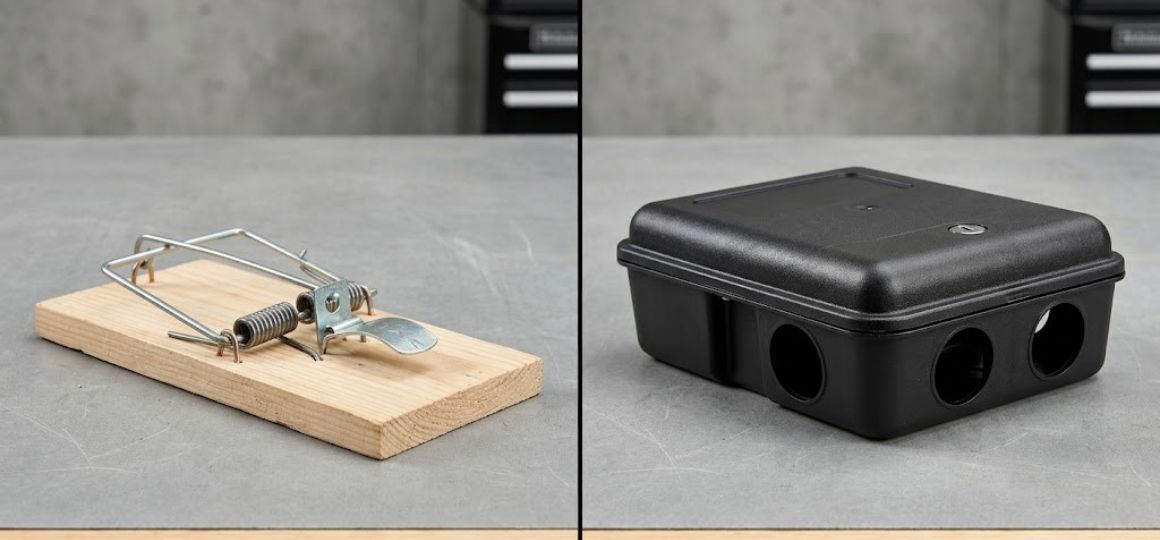
What snap traps do well — and what they can't do
Snap traps — specifically the standard snap-bar style and the enclosed box designs — are the most appropriate interior treatment tool for residential rodent problems in Greensboro. They produce a recoverable carcass, which means you know immediately when a catch occurs and can remove it before decomposition begins. They provide visual confirmation of species — the trapped animal is identifiable. And for households with children or pets, they can be placed in inaccessible locations (inside cabinet bases, behind appliances, in crawl-space access areas) without creating a secondary poisoning risk.
Snap traps also have a significant behavioral advantage: roof rats and house mice are generally less neophobic than Norway rats, meaning they'll engage with a fresh trap without the multi-day pre-baiting period that Norway rats require. A snap trap placed along an active mouse runway on Monday night often produces a catch by Tuesday morning.
What snap traps can't do: they address the individual animals currently in the structure but do nothing to reduce the source population outside the structure. A crawl-space snap-trap program that catches 8 Norway rats doesn't reduce the 30 additional Norway rats in the yard burrows adjacent to the foundation. Snap traps are the interior tool; they need to be paired with an exterior tool for any established Norway rat infestation.
What bait stations do well — and what they can't do
Tamper-resistant exterior bait stations are the appropriate tool for addressing the outdoor colony — the source population that sustains interior pressure. Bait stations placed at the building foundation perimeter, adjacent to dumpster enclosures, near storm-drain outfalls, and along fence lines that Norway rats use as travel corridors intercept rodents in the exterior environment before they reach the structure.
The mechanism: a Norway rat that feeds from a bait station receives a lethal dose of second-generation anticoagulant rodenticide. It doesn't die at the station — it returns to the colony, dies in the burrow or in open ground within 4–7 days, and is recoverable by scavengers or weather. This is preferable to rodenticide bait placed indoors, where carcasses die in walls and inaccessible locations.
Current EPA regulations require tamper-resistant housings for any second-generation anticoagulant rodenticide placed outdoors or in areas accessible to children and pets. Loose bait placement without a housing is illegal for most current rodenticide formulations and creates secondary poisoning risk for raptors, hawks, and owls that may consume carcasses. Every bait station we install is a tamper-resistant housing placed per EPA label requirements — this is not optional, it's regulatory.
What bait stations can't do: they don't produce recoverable carcasses from interior walls. Placing interior rodenticide bait in a Greensboro residential home risks animals dying in inaccessible locations, decomposing, and producing weeks of odor. For interior work, snap traps are the tool.
Why interior bait placement is a mistake in Greensboro residential homes
The scenario Greensboro Rodent Control sees regularly when following up on someone else's failed program: a homeowner hired a pest control company, the company placed rodenticide bait blocks inside kitchen cabinets or under appliances, the rodents ate the bait, crawled into wall cavities to die, and the homeowner is now experiencing the decomposition odor in the living space that lasts 3–6 weeks and requires dead-rodent extraction work.
This happens because placing bait indoors is faster and cheaper than deploying a properly positioned snap-trap network. It's also wrong for Greensboro residential applications where children, pets, and family members are present, and where rodents dying in walls creates a second problem on top of the first.
The distinction between interior and exterior tool use is not just a preference — it's a risk-management principle. Snap traps for interior residential environments. Bait stations in tamper-resistant housings for exterior perimeter programs. Never rodenticide bait loose inside a home.
The right combination for each Greensboro rodent scenario
Seasonal mouse influx in a Greensboro suburban home: Interior snap traps along confirmed travel routes (under sink, behind refrigerator, in garage) plus foundation exclusion sealing to close the entry. No bait station needed for a contained mouse problem in a lower-pressure area.
Established Norway rat crawl-space infestation: Pre-baited crawl-space snap traps for the interior population plus exterior tamper-resistant bait stations targeting the yard and storm-drain-adjacent source colony. Both tools running simultaneously. Foundation exclusion sealing after crawl-space clearance is confirmed.
Roof rat attic infestation: Attic snap-trap network along confirmed travel paths. No bait station in the attic — recoverable carcasses are essential when working in an enclosed overhead space. Exterior perimeter bait stations add value for properties with yard Norway rat pressure co-occurring.
Commercial restaurant with Norway rat pressure: Interior snap traps in back-of-house inaccessible areas (equipment kick plates, utility chases, under dishwasher). Exterior tamper-resistant bait stations at the building perimeter, dumpster enclosure, and alley adjacency. The split between interior and exterior tools is the same — the only difference is scale. Call (844) 635-0403 if you'd like to discuss the right tool combination for your specific Greensboro property.
Rodent problem in Greensboro or Guilford County?
Free inspection, same-day dispatch available, written quote before any work starts. Licensed in North Carolina. Open 24/7.
Call (844) 635-0403